Thursday, May 23, 2013

How How the Grinch Stole Christmas Stole How the Grinch Stole Christmas' Christmas


Tis the season for my television to be dominated by Christmas specials, and there is no Christmas special more special to me than the Dr. Seuss/Chuck Jones animated How the Grinch Stole Christmas.


I could go on and on about its brilliance, its hilarity, its ability to drive home just how magical Christmas can be without drowning in saccharine babble and heavy-handed religious themes. It's a story about giving, community, and redemption. It's perfect.


Every now and then I'll see "How the Grinch Stole Christmas" on my cable menu, jump over to it, and find myself smack-dab in the middle of the Jim Carrey-starred Ron Howard-directed live action version and I'm taken back to the year 2000 . . .
 
A few days after the Grinch release I dragged my then-girlfriend to a Tuesday matinee, hoping to avoid as many screaming children as possible. Having always been a big Jim Carrey fan, I was excited to see what he would bring to the slimy garlic-souled villain. With Anthony Hopkins taking over Baris Karloff's narration duties, I figured it was a surefire hit. The girlfriend pointed out that we were the only people in the one-third capacity theater who didn't bring a child.


It took about forty-five minutes of this thing to get me to audibly exclaim, "This is bullshit!" In a state of rage and disbelief, I sat glued to my chair like Alex from A Clockwork Orange as horror upon horror bombarded me. I groaned when Cindy-Lou Who warbled a nails-on-chalkboard Christmas song. I choked on Sour Patch Kids when Grinch Carrey oversang a big-band version of the song "You're a Mean One, Mr. Grinch." After about the thirtieth mirthful Grinchy wisecrack I was making such a scene that the girlfriend remarked that she did, in fact, bring a child and he was misbehaving. After the credits rolled I zombie-walked back to the car, pretty much the same vacant-eyed shuffle-step that followed my first viewing of Requiem for a Dream.


I'm not some cover-thumping purist, far from it. I'm the guy who thinks that the Harry Potter movies became good when they started straying from the books. I'm the guy who loses huge fanboy points by thinking that having elves show up at the battle of Helm's Deep in The Two Towers was a great idea. Film and literature are two entirely different art forms, and remaining 100% faithful to the book is a surefire way to make a clunky, if not crappy, movie.
 
The perfect example of how to be slavishly faithful to the source material yet also screw it up? Take a quick look at Zack Snyder's well-intentioned but flawed adaptation of Watchmen. The dialogue is lifted, word-for-word, from the book. There are dozens of shots that are straight-up photographs of panels from the comic. The movie was instead submarined by its super-stylized and ultra-violent fight scenes. Snyder missed the point that this was a story about ordinary people who, with the exception of Dr. Manhattan, have no powers. He missed the point that having Silk Spectre and Nite Owl kill and maim thugs in a back-alley brawl flew in face of their disdain for Rorschach's violent tactics. He missed The Point.


And that's what Ron Howard does. He misses The Point.


I don't fault Jim Carrey too much for his performance; he was funny, he was bombastic, he was a human cartoon. He brought life and emotion to the table from underneath eighty pounds of makeup and fatsuit. However, he brought the wrong life, the wrong emotion, and much of that blame falls on the director.


The Grinch is not supposed to be a high-energy tornado of comedy. The Grinch is a scumbag, a thing that oozes across the screen instead of being catapulted across it. He's not a mess of espresso and crystal meth, he's a three-decker saukerkraut and toadstool standwich. With arsenic saaaauuuuuce!
 
The actors did everything that they could do with the script and direction they were given. But oh that script. That goddamn script. That's Carrey's greatest sin: reading that script and not realizing that it stinked, stank, stunk.


I understand that it's difficult to fill an hour and a half with a picture book. Seuss and Jones needed to stretch it a bit just to fill the 21 minutes and 36 seconds of the cartoon. You can add anything your little heart desires to the story so long as you keep it faithful to the spirit of the source material, the Point. Spike Jonze proved it with his brilliant adaptation of Where the Wild Things Are.


If you haven't seen either or both of the Grinch versions, here are capsule plot outlines:
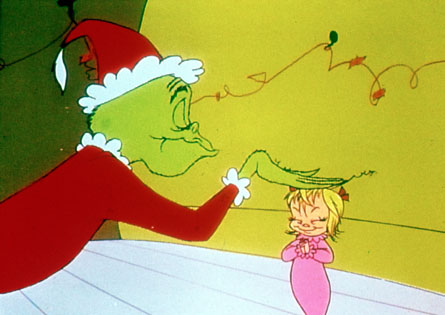
The original: The Whos are a happy little community that loves Christmas. The Grinch, a cave-dwelling monster whose heart is two sizes too small is a vile thing that hates Christmas, the Whos, and their holiday singing. On Christmas Eve he dresses up like Santa, steals all their stuff in the middle of the night, dupes the adorable Cindy Lou Who, and heads to the highest mountain to pitch their Christmas. As he listens for the sounds of weeping and misery, he instead hears their Christmas singing. His heart grows three sizes, he realizes Christmas isn't about materialistic bullshit, and he gives back all of the Whos' stuff and becomes a part of their community.
 
The remake: The Whos are a materialistic community that loves Christmas. When the Grinch was a baby, he was left in a basket on a Who doorstep. Throughout his entire childhood, the Grinch is constantly teased, harassed, and psychologically abused to the point where he flees Whoville and becomes this vile monster whose heart is too sizes too small. Years later, Cindy Lou Who convinces the Grinch to come back to Whoville and make amends. He reluctantly agrees but is thrown into a fit of rage when he is again belittled by the Whos. On Christmas Eve he dresses up like Santa, steals all their stuff in the middle of the night and heads to the highest mountain to pitch their Christmas. When he finds that Cindy Lou Who has stowed away on his sled o' swag (which, by the way, has rocket engines) his heart grows three sizes and he saves her and the sled. They return to Whoville, where the Whos are broken up about their crap being stolen, and he gives back all of the Whos' stuff. Their hearts are warmed by Cindy Lou and the Grinch, and he becomes a part of the community.


To be perfectly honest, I may have missed a thing here or there, because I haven't seen it in nine years and it was a very traumatic experience. However, that's the gist.


We can all see the minor changes, right? In Howard's version, the Whos are the villains. The Grinch tried and tried again to fit in, but he was pushed to the point of villainy. His motive wasn't out of hate and ignorance, it was vengeance. Honestly, the Whos in this movie deserved to be robbed. The Grinch's heart didn't grow by realizing the true spirit of holiday love and cheer, it grew because he was about to inadvertently murder the one person who showed him kindness.


Don't get me started on the Grinch's romatic subplot with the foxy "Martha May Whovier."
 
Seuss' general disdain for big business and greed is evident in his original masterpiece, both in book and cartoon form. Christmas is about bringing people together, about love and forgiveness. All of the presents and decorations, well, that's just bonus. The Point of Howard's remake is twofold: 1)Eff with the bull, get the horns. 2)Cute blonde girls heal all wounds.


My Christmas wish this year, as it has been every year this decade, is that someday this live-action thing will fade away and be mostly forgotten, and once again the voice of Boris Karloff will usher in egg nog and snow flurries. Until then, my friends,


Welcome Christmas while we stand

Heart to heart and hand in hand.


(Many thanks as always, to Theodor Seuss Geisel, Chuck Jones, Boris Karloff, and the google image search. Several go-to-hell's to Audrey Geisel, Ron Howard, and my complete lack of HTML knowledge.)

Trent on the Mound

Originally published December 10, 2009

Casey at the Bat vs. Trent on the Mound

The outlook wasn't brilliant for the Mudville nine that day;
The score stood two to four with just one inning left to play.
The Mudville fans all wrung their hands for much to their lament,
In strode Wespen Falls' new closer, phenom rookie Jackson Trent.

Mudville's Bobby Cooney, often injured, overpaid,
Thrice swung and missed and the crowd hissed, dejected and dismayed.
Charlie Barrows had huge stats, lead the league in OBP,
But when crunch time came he came up lame and the strikes were totalled three.

The rookie Jackson Trent, he surely had his stuff that day:
The heater popping, the curveball dropping two feet below its prey.
Trent only needed one more out to slam the door for good,
And looking at the lineup Mudville feared that Jackson would.

In the box stood Flynn, an aging slugger with no eye.
On deck was Jimmy Johnny Blake, the king of weak pop flies.
So long as mighty Casey couldn't get a chance at that-
The fear was Casey, MVP, would step up to the bat.
 
But Flynn let fly a single, to the wonderment of all,
And on a hanging curve Blake tore the cover off the ball.
And when the cut-off man was hit, Trent saw what had occurred:
There was Jimmy safe at second and Flynn a-hugging third.

The Mudville fans united and there rose a frenzied yell,
For every shirtless goof to every pink-hat-wearing belle
Stood tall, applauded one and all, ceased all idle chat,
For Casey, mighty Casey, was advancing to the bat.

There was showmanship in Casey as he strutted to his place;
There was pride in Casey's bearing and a grin upon his face.
The armor on his arm was fixed and on the ground he spat,
No stranger in the crowd could doubt 'twas Casey at the bat.

Poor Jackson Trent stepped off the mound and tossed the rosin bag.
The cheers turned into jeers for him from those in Casey swag-
"Well this sure sucks," thought Jackson as he gripped the baseball's seams,
For it wasn't long ago that Casey batted for his team.

See Wespen Falls was small-time, the smallest payroll in the game,
And just last year big Casey left for fortune and for fame.
A year ago they proudly hung the pennant for the league,
And promptly traded all their stars, even closer Dougie Teague.

Mudville with their pockets deep and their checkbook primed to spend,
Went on a spending spree that guaranteed they would contend:
They first signed two more starters: Rick Chavez and Ike Lefleur;
They signed two guys, then signed two guys, and then they signed two more.

They spent more than the GDP of any third-world nation;
They even gave their batboy eighty grand in arbitration,
But worst of all they inked the mighty Casey, and his stats
Ensured that pitchers trembled when mighty Casey was at bat.

With no Doug Teague the Wespen bullpen had a glaring hole,
With none willing and none able to step in the stressful role,
But from the draft a twelfth round pick, the youngster Jackson Trent,
Rose quickly through the ranks as every bat he did torment.

One and all in Wespen Falls made Trent his favorite son,
When his strikeouts started piling up and his WHIP dipped under one;
The common fan of Wespen Falls who counted every cent,
Could admire and identify with the jersey that read "Trent."
But here he stood facing murderous wood and sweat dripped from his brow;
He knew that he could beat him but he didn't quite know how-
One look towards his dugout filled young Jackson with despair:
His manager was holding four fat fingers in the air!
With first base open, common sense said issue a free pass,
Trent shook his head and glared right back as if to say, "My ass!"
The catcher called for time and ran onto the pitcher's mound;
The manager came after and the infield gathered 'round.

"I should bench you and demote you and send you to double A!
For the childish disobedience that you have just displayed!
You belong on the bench in the locker room, you belong up on a shelf!
So young man, if you think you can, what say you for yourself?"

The natives grew rude and restless and the screams did shock his ears:
The lewdest names and verbal flames drenched in too many beers.
Trent closed his mind, he shut them out, looked his manager in the eye-
"Please coach, all I ask of you is that you let me try.
Just look at big cash Casey and his million dollar grinning!"
Trent's blood boiled, "Mudville is spoiled, they're too used to winning!
Their playoff spot is clinched and our season's hopes have died,
If you say so then I'll walk him," Trent took a breath and sighed-
"They play for ratings revenue, what we play for is pride."
 
The ump then joined the huddle and he did puff his chest-
"This meeting has gone on too long, now back to the contest!"
The manager nodded and gave a manly smack to Jackson's rear-
"I have no doubt, just strike him out and let's get out of here."

Trent checked the man at second and he checked the man at third,
His leg went up his foot went down and the ball hurtled homeward:
It nipped the inside corner and lit up the radar gun;
The catcher's mitt exploded and the umpire screamed, "Strike One!"

The crowds broke loose in fury and the patrons all did curse-
"Use the good eye, ump!" one said, and others shouted worse.
Then Casey fixed his helmet and Jackson fixed his shirt;
Then Casey dug his heels far in and Jackson toed the dirt.

Trent settled in the stretch, more confident than before;
He unleashed a twelve to six curveball that snuck in the back door.
All noise abated as the crowd waited for what the ump would do:
He paused for just a moment, then the umpire yelled, "Strike two!"

Casey faced the ump and yelled, "You chump, that was outside!"
"Say that again, I'll kick you out," was what the ump replied.
Casey stepped back to the batter's box, no longer with a grin,
Trent waited for his catcher's signal: hard and up and in.
 
And now the crowd is rising in support of their hero.
And now young Trent, free from fear, faces his mighty foe.
And now the pitcher holds the ball, and now he lets it go.
And now the air is shattered by the force of Casey's blow.

Oh, somewhere in this favored land the sun is shining bright,
The band is playing somewhere, and somewhere hearts are light,
And somewhere all are laughing, and somewhere children shout,
But there is no joy in Mudville, mighty Casey has struck out;
And in Wespen Falls the joy will soon be washed away by tears,
For one and all know Jackson Trent will be traded in three years.


(Thanks to Ernest Thayer for the original poem and to Alex Pean for naming Jackson Trent.)

The Elf Is Watching

Originally published December 18, 2009

The Elf is Watching

Everybody enjoys a good holiday tradition, and there is no time more rife with them than right friggin' now. How does a holiday tradition start? I'll break it down for you, real simple like:

1)Somebody does something.
2)Somebody else thinks that the aforementioned something is awesome.
3)Repeat.

The best traditions seem to just begin accidentally and catch on organically. About ten years or so ago my best friend and I stopped at a gas station Thanksgiving morning for cigarettes. The festive and beaming Indian man who sold me my smokes flashed a bright and joyous smile and said, "Happy Chicken, my friend!" My buddy and I held our composure until we left the store and then promptly doubled over and laughed for a good twenty minutes. We then spent the rest of the day wishing everyone a "Happy Chicken." The next year, most of my friends and family wished me a Happy Chicken before I could even get around to it. Now, every Thanksgiving consists of my cellphone blowing up with Happy Chicken texts and my Facebook homepage being half-filled with Happy Chickens. I am fairly certain that there are people who I have never met wishing one another a Happy Chicken, and the mere thought of it fills me with holiday cheer.

Which brings me to the newest holiday tradition sweeping the nation one $29.95 box at a time: The Elf on the Shelf:
 

If you haven't yet heard of it, here's the gist:

This elf doll is actually alive: a magic scout elf who keeps a constant eye on you. Every night while you sleep he flies to the North Pole and fills Santa in on your exploits, be they naughty or nice. He's always back the next morning, only in a different spot than where you last saw him. You can talk to him, tell him what you want for Christmas, and he'll put it in your file and let St. Nick know. Just whatever you do, don't touch him:

There's only one rule that you have to follow
so I will come back and be here tomorrow:
Please do not touch me. My magic might go,
and Santa won't hear all I've seen or I know.
I won't get to tell him that you've said your prayers,
or helped to bake cookies,
or cleaned off the stairs.
How will he know how good you have been?
He might start to think you forgot about him.


Am I the only one who finds this a little bit creepy? Not just the bizarre threat of possibly ruining Christmas if you lay so much as a finger on your elf, but the fact that this yuletide Chucky moves around at night and shows up in a different spot each day?
If I had gone to bed as a child, told that my Optimus Prime was wearing a wire for the Easter Bunny, and then woke up with Prime on a completely different side of the room . . . well, I would've lost my goddamn mind. It was hard enough trying to fall asleep some nights with the various monsters and creeps that lurk in the shadows of a child's bedroom, but with a living doll staring at me? Gaaghckk!!

(shudder)

As much as this "tradition" bothers me, nothing drives me more bonkers than the picture book that explains everything in rhyme. Why does this book rankle me so? Because it's a heaping pile of shit, that's why. The rhymes are middling and mediocre at best and the art is the epitome of amateur hour. It's this sucky faux-retro garbage that's meant to look old and vintage like those dog-eared children's books you find in antique stores next to the out of print Little Black Sambo with the original racist drawings. The Elf on the Goddamn Shelf with old-timey art is like the pre-faded and tattered clothing you buy at Abercrombie and Fitch: fake old.

Traditions aren't supposed to be something new, they're supposed to be old and cherished from some long-forgotten legend. The Elf on the Shelf, once you strip away the old-timey Howdy Doody doll and crappy retro art, is twenty years younger than Secretary's Day. In the 70's a lady by the name of Carol Aebersold was asked by her children how Santa was able to tell if they were being naughty or nice. Rather than using the most popular excuses ("nobody knows," "your father and I talk to him on the phone," "God tells him," "he has mind powers like Professor X") Aebersold whipped out a toy elf and outed it as a spy. A tradition was born!


I can get behind that. I can even get behind packaging a freakish elf with a book and getting stinking rich off of it . . . because isn't that the true meaning of Christmas? I can totally get behind a self-published independent book blowing up. What I cannot get behind is just how toilet the book is.

No matter how many John Muth's there are making gorgeous works of art between the pages of picture books there will always be a Coe Steinwart (the Elf artist) to fuck it up and set the perception and expectations of children's books back twenty years. Steinwart is the Matchbox 20 to Muth's Nirvana, the Limp Bizkit to Kadir Nelson's Rage Against the Machine. You really want to start a tradition? Let's start the tradition of quality books! Not the tradition of--gaaghk!


Oh, that terrifying rascal! Where will he show up next?

The final page of The Elf on the Shelf reads:

This tradition began for the _________________ family
on ____________, 20___.
We welcomed our elf by choosing the name: _________________.


It feels so forced and phoney to me, a book shamelessly begging to be a keepsake. I just don't think you can force a real tradition, even if you throw the word "tradition" on the cover, but if you really must try then don't try with a crappy book and a creepy doll.


Don't forget next November to wish everyone a Happy Chicken!

(That'll be $29.95 please.)

Alyss in Blunderland

(originally written January 5, 2010)

Alyss in Blunderland -or- You Could Have Done Beddor -or- Boooooooaaashhkk!

"But I don't want to go among mad people," Alice remarked.
"Oh, you can't help that," said the Cat. "We're all mad here. I'm mad. You're mad."
"How do you know that I'm mad?" said Alice.
"You must be," said the Cat. "or you wouldn't have come here."


I love Alice and her amazing friends/foes. If you don't, well, I feel sorry for you. Horribly, terribly sorry for you. It's as if you don't like chocolate or the smell of seawater: you're just plain missing out.


I love Alice and her amazing friends/foes. If you don't, well, I feel sorry for you. Horribly, terribly sorry for you. It's as if you don't like chocolate or the smell of seawater: you're just plain missing out.

I also happen to be a big fan of adaptations/reimaginings/hellspawn of Lewis Carroll's work. The Disney version is one of my favorite things that The Mouse has produced and I don't know about you, but I'm quite looking forward to Tim Burton's version as he attempts to redeem himself for that well-meaning but fatally flawed Charlie and the Chocolate Factory.

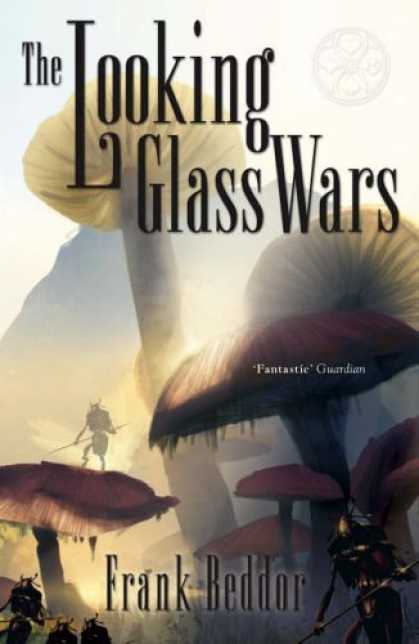
I regularly thank the Gods of Public Domain, for there are creators that (to varying degrees of success) dare to step even further out. My favorite Batman story, Grant Morrison and Dave McKean's horrifying Arkham Asylum, is based on Carroll's work. Christopher Myers' adaptation of Jabberwocky is one of the most original picture book concepts in the past several years. And then there's the current most money-makingest of Wonderlands, at least until the Burton movie hits theaters, that which comes from the mind of Frank Beddor, author of the Looking Glass Wars trilogy.
 
I read the first book a few months before its American release and it was one of those stay-up-until-the-sun-comes-up fast reads. If you haven't heard of it, here's the gist:

Alyss (pronounced "Alice") Heart is the princess of Wonderland, a parallel universe and magical Queendom where all of earth's inventions, be it watercolor paints, the AK-47 or iPod, originally come from. Some of Wonderland's residents have the imagination of an Edison while others, like the Queen, have the imagination of a Gandalf, imagination that manifests itself as a dominant magical superpowers.

Alyss' evil aunt, Redd Heart murders Alyss' parents and usurps Wonderland's throne. Young Alyss is whisked away to Earth (England in the 1860's to be precise) for her own safety. Her imaginative powers slowly wane the longer she is away from Wonderland, and she slowly begins to doubt Wonderland's existence as her tales are repeatedly mocked and chalked up to childhood fantasy. She eventually finds one grownup who will listen: Charles Dodgson, aka Lewis Carroll. Alyss tells him everything about the evil Redd Queen of Hearts, about Redd's right-hand assassin The Cat, about Alyss' own ninja/samurai/superspy/bodyguard Hatter M, et cetera. Dodgson eventually takes some liberties and publishes his sanitised and warped version as Alice's Adventures in Wonderland. Alyss is apalled, betrayed, and it is then that she gives up and fully commits to being a "normal" Briton.

Hatter M, meanwhile, has spent the better part of a decade roaming around Earth to try and find his princess. He eventually does and must hurry her back to Wonderland where she must rediscover her powers, overthrow Redd, and save the day. Battles ensue. Deaths are avenged. Sequels are foreshadowed.
I enjoyed the book. A lot. It wasn't brilliant literature by any stretch of the imagination (pun unintended) but it was a great young adult page-turner and an extremely fun read. It has its flaws, primarily a forced and superfluous love story, but all-in-all worth losing a night's sleep. What truly made it was the fantastic middle part of the novel that takes place on Earth, the bit where poor young Alyss/Alice comes to question her own sanity and finally chooses a normal adult life over the partial madness of childhood. That theme, and not the cute name changes of all of the iconic characters, is what makes this a true homage to Carroll's work.

"How do you know that I'm mad?" said Alice.
"You must be," said the Cat. "or you wouldn't have come here."


A few years later the sequel, Seeing Redd, hit the shelves. Here's the user review I posted on Barnes and Noble's website:

Wonderland's Sophomore Slump

Posted February 23, 2008, 3:40 PM EST: I enjoyed Beddor's 'Looking Glass Wars' a good deal. What truly set it apart from standard sword and sorcery fantasy, aside from the Carroll roots, was its wonderful second act. The middle part of 'Wars' was rich with mystery and psychological complexity. Mystery and complexity, however, are nowhere to be found in 'Seeing Redd.' The only thing resembling complexity is the chasm between the two warring queens: Alyss and Redd. Alyss' character has become horribly dull and does not evolve one iota throughout the novel. Redd is what she was before: a hilariously evil, sterotypical, and entertaining character. Continually jumping back and forth between the dry heroes and colorful villians makes the novel seem disjointed . . . and makes me root for the villians. The 'twist' ending that Beddor throws in is nothing more than an easy open-ended cop-out. Here's hoping book three is better.


I wish I could tell you what that "twist ending" is, but I've since completely forgotten, which is a testament to the overall lameness of the book. When the conclusion, Arch Enemy, hit shelves I could only fight off the temptation for so long. I suffer from the great curse of sequels: can't ignore 'em, almost never like 'em.

Which brings me to Arch Enemy.
My capsule review: Bwwoorrllkkk.

It became obvious fairly early on that Beddor completely mailed this one in and, if the rumors of an impending movie adaptation of the books are true, it seems like he just spat this thing up there for an eventual screenplay. Not that I can ever make excuses for crappy paint-by-numbers books, but I understand when a Thomas Harris spits out a Hannibal Rising to make another yacht payment. But when the first movie based on the first book of your trilogy isn't even greenlit? Tsk tsk tsk.

Arch Enemy has no idea what kind of book it is; it's chock full of stock battle sequences with a sprinkling of star-crossed love and a heaping dose of daddy-issues . . . but completely impossible for the reader to take it seriously when so much of it is so damn goofy. From the absurdly named Weapon of Inconceivable Loss and Massive Annihilation (or WILMA), to ridiculous weapons such as the "oozy," (a gun that shoots goop) much of the book comes across as drunken James Bond Mad Hatter Libs. The writing is atrocious, and the use of sound effects is absolutely insane.

Zeeeerrroww!

Constantly, throughout the book, if something happens that causes a sound, a sound effect is actually written. For instance:

Pffffffaaa!- The transport shook. Outside, Alyss could hear the metallic wheeze of unfolding cannonball spiders, the scuffle of running feet, panicked voices.
Dodge pulled a slender rod from the top of his boot, and--Fwathump! The rod opened like an umbrella from earth, its webbing shielding him and Alyss from incoming shards.


-or-

Alyss fell toward the Pool of Tears, he feet pointed down and her arms held close to her body.
Kersplassshhhh!
She plunged through the water . . .


-or-

Eeeeeeeeeeeeeeesh! A mauler shard whistled by her head.

Every fight scene, and there are a lot of fight scenes, are laden with fffshaw!'s and fi-fi-fi-fi-fith!'s and fweppap!'s. It grated on me after a while, but what annoyed me most was the inconsistency of the noises. As a lifelong comic book fan there are few things I love more than the snikt! of Wolverine's claws popping or the thwip! of Spider-Man firing off his web-shooters. An iconic sound effect is created by using it repeatedly, not by overusing it mind you, but by staying consistent.

The defining weapon of Beddor's Wonderland is the AD-52 (Automatic Dealer, fifty-two card deck) that shoots out razor-edged playing cards. The inside cover of Arch Enemy is a detailed schematic blueprint for the AD-52 and inside the actual book it's as popular as pistols and sunglasses in The Matrix.

The AD-52's razor cards, however, never seems to make the same noise twice. During one battle they splinter a floor: Thimp thimp thimp thimp! Later in the book they are embedded in a wall: Fith fith fith fith fith. When Alyss conjures the cards with her imagination: fiss, fiss, fiss! Perhaps different decks of cards make different noises, Bicycle playing cards more aerodynamic than the novelty ones with naked ladies on them. Or perhaps Beddor was just lazy.
And then there's the "orb generator," a kind of small low-level tactical nuke that's used in various battles. Beddor saves his most awesome of sound effects for the orb generator:

Booooooooooaaaashhhhhhhhhhhhhhkk!

That's what it sounds like when it erupts, or explodes or generates or whatever it is that it does, in the sky. When it hurtles through the forest however, it's all like feeeeeeeeooooooshhhhkaaaghghgk! Aaaah, but the best is saved for last. The climax of the book comes when Alyss does the unthinkable and generates the largest orb generator in the history of Wonderland:

Boooooooooooooooooooooooooooshhhhhhhhhhhchchchchchkkckck!

That's right. Twenty-seven o's and eleven h's. I counted. My eyes were all like, beoioioingggg! and my jaw went all schajok! Then I poured myself a another whiskey-glukglukgluk- and drank it -ghhp, ghhp, aaaaaahhhh- and was all like bwah ha ha ha ha ha!

And I closed the book-fwap!

I can't remember if the first two books went this crazy with the sound effects, but if so then they at least must have had some substance to distract me from the absurdity. And that's what it is, absurdity.
What truly blows my mind about Arch Enemy and the trilogy in general is just how lazy it all feels, particularly considering the Looking Glass Wars empire Beddor is attempting to create. Check out the website if you have some time to kill. It boasts an online card game, updates on the development of a rollercoaster-chk-chk-chk-chk-chk-zzzrrrrooooowwwwssshhhh!- and information on the development of the movies. There is also a series of teen graphic novels based on the solo adventures of Hatter M.

I read up on Beddor, and you can see why he views everything as culminating with a film empire; the guy is a producer, credits including There's Something About Mary and Wicked. Know what this guy is working on now? He's developing the story for the new Ridley Scott movie: Monopoly.

If this is your first time hearing it, I'll give you a moment to let that sink in.

Monopoly. The Movie.

Wuhwuhwuhwuh-wuzzattt!? Zzzzvvrrooommm!

At this point I'm now completely off topic, but I'll leave you with a nice long quote from Beddor talking about the movie, showing off his great powers of imagination. Hopefully little Scotty dogs can distract him long enough to forget how wide open he left his trilogy for a fourth installment.

"I wrote the story that got Hasbro excited and I attached Ridley Scott. The project was underway but they were in a little bit of trouble I guess and they were looking for a way to actually turn it into a movie. I had a pretty interesting take and it got Sir Ridley interested ... "
"They have this big world and this game -- it’s the most famous board game in the world -- and it just really came out of the whole 'Alice' thing. I took the approach of thinking of the main character falling down a rabbit hole and into a real place called Monopoly City ... It was the re-engineering of 'Alice in Wonderland' that got me thinking and then with this it came around full circle and I was able to utilize that. That’s a big world. They were searching for that."

"I created a comedic, lovable loser who lives in Manhattan and works at a real estate company and he’s not very good at his job but he’s great at playing Monopoly. And the world record for playing is 70 straight days – over 1,600 hours – and he wanted to try to convince his friends to help him break that world record. They think he is crazy. They kid him about this girl and they're playing the game and there’s this big fight. And he’s holding a Chance card and after they’ve left he says, ‘Damn, I wanted to use that Chance card,’ and he throws it down. He falls asleep and then he wakes up in the morning and he’s holding the Chance card, and he thinks, ‘That’s odd.’"

"He’s all groggy and he goes down to buy some coffee and he reaches into his pocket and all he has is Monopoly money. All this Monopoly money pours out. He’s confused and embarrassed and the girl reaches across the counter and says, ‘That’s OK.’ And she gives him change in Monopoly money. He walks outside and he’s in this very vibrant place, Monopoly City, and he’s just come out of a Chance Shop. As it goes on, he takes on the evil Parker Brothers in the game of Monolopy. He has to defeat them. It tries to incorporate all the iconic imageries -- a sports car pulls up, there's someone on a horse, someone pushing a wheelbarrow -- and rich Uncle Pennybags, you're going to see him as the maĆ®tre d' at the restaurant and he's the buggy driver and the local eccentric and the doorman at the opera. There's all these sight gags."


(Above image not actually a Beddor/Scott approved sight gag . . . I think. Thanks, Google Images! Rrrrriippp--eeeeeeaaaaarggghhhg!)

The Softer Side of Glenn Beck

(Originally published December 1, 2009)


Okay, in the interest of full disclosure, it is my duty to be completely honest and state that I do not like Glenn Beck. There you have it. But I implore you, kind reader, do not accuse me of liberal bias otherwise I will be forced to write a nasty nasty blog post about you that no one will ever read. So check yourself.


As a picture book aficionado, I pride myself on not letting politics get in the way of enjoying a quality book. Lynne Cheney, wife of one of the most odious men on the planet, wrote several quality picture books, one of which (A is for Abigail: An Almanac of Amazing American Women) will be in my future child/children/childlike robotic construct's library. Granted the book owes much of its pop to a brilliant performance by Robin Preiss Glasser of Fancy Nancy fame, but let's give the wife of the devil her due: she wrote an excellent book that I have recommended to more than a few people. If you want a book for your child that celebrates women from Edith Wharton to Sandra Day O'Connor to Mary Martin then I recommend it to you as well.


So don't fault me for calling Let's Read About It, penned by Laura and Jenna Bush and drawn by Denise Brunkus (Junie B. Jones), one of the worst picture books of the decade. My back-to-back votes for Nader have nothing to do with despising this inane drivel and giving it a user review so scathing that barnesandnoble.com refused to print it, despite a complete lack of foul language and the only user review in history to boast near-perfect grammar.


So don't fault me for giving The Christmas Sweater somewhere between a "meh" and a "blah."


I swear to you, I had a completely open mind when I sat down on my couch ready to get my Beck on. That mind was immediately changed from open to only slightly ajar when I saw the title page. I couldn't find a pic on the first five pages of a google images search, so I'll give it my best approximation:
The Christmas Sweater

A PICTURE BOOK

Illustrated by Brandon Dorman

Adapted by Chris Schoebinger

Original story by

GLENN BECK with

KEVIN BALFE and JASON WRIGHT
 

I knew going into this that Beck released the original Sweater, a grownup novel, last year around this time. I didn't read it and had no idea that he had not one but two helper writers. I did not know that he didn't even write the book that I was holding in my hands. It was adapted by someone else, adapted from a book that two other people helped him write. Which now makes it even easier to judge the book without bringing in my prejudice; he didn't even write the thing.


Anyways, it's really quite standard wannabe Dickens fare: a scroogey character (Eddie, a little boy who wants nothing but a bike) is led by something mystical (the unwanted gift of a sweater . . . which turns out to be a magic sweater) through a journey (a dream sequence) that has three major segments (sledding with his Dad, making a gingerbread house with his Mom, flying in a reindeer-pulled sled with his Santa-resembling grandfather). It all comes together nicely when he awakens from his dream, runs downstairs, and completely ignores his fancy new bike as he marvels at his new hand-knit sweater. Schoebinger's words are unremarkable and forgettable, which really is a shame because these types of stories can be saved by a heaping dose of style: a poetic and gorgeous bit of prose that Schoebinger doesn't even begin to approach. Instead it reads like every adaptation to every Disney movie: lifeless and sterile.

 
All of that being said, some beautiful artwork might have salvaged this book. Brandon Dorman certainly possesses the skills, as shown in his eye-popping work on Jack Prelutsky's The Wizard. Dorman shows flashes of a Chris Van Allsberg sensibility here and there, but overall his work on The Christmas Sweater comes up a bit short. In a vacuum all of the individual pictures are lovely indeed, but the emotion and magic never quite comes together. Eddie's expression barely changes throughout most of the book leaving him looking wooden and, well, kind of creepy. One of the last pictures, a shot from behind Eddie as he sleepily creeps down the staircase on Christmas morning, is absolutely gorgeous . . . and it's no coincidence that it's the only picture of Eddie that excludes his face. Dorman's use of light and shadow is truly fantastic and a few of his portrayals of adults are vibrant and full of life, but if you can't inject an emotive quality into the face of your main character, what's the point? He should have, and can, do much better.
All in all, there's really no reason to buy The Christmas Sweater. There are loads of picture books with similar themes that are better on every single front. The only reason anyone would buy into this mediocrity would be because of the "Glenn Beck" slapped right at the top of the cover . . . of the book he didn't write.

City Dog, Country Frog

Aerosmith & Run-DMC.
Jimmy Stewart & Alfred Hitchcock.
Watermelon & Goat Cheese.
Occasionally two individually brilliant concepts will unite to form a force of nature the likes of which you had never concieved. Sure, after the fact it makes perfect sense, and not only do you wonder why it took so long, but you wish you could have discovered it earlier.
The other day I saw this book cover and my head exploded:

Jon Muth is arguably the best illustrator working in picture books today; his The Three Questions and Zen Shorts are the kind of brilliant melding of parable and painting to which all Chadult* books aspire.
Mo Willems is a prolific monster of a writer/illustrator, selling kazillions of books between his clever Knuffle Bunny books and hilarious Elephant and Piggie and Pigeon series. He's the rare artist who simply does not publish lackluster material and the closest thing to Dr. Seuss that this generation has to offer. There are only two major things that, in my mind, separate Willems from the good Doctor:

1)He's not a stone-cold rhymer. Instead, Willems' weapon of choice is a converstional style heavily influenced by comic strips. 
2)He hasn't risen above the level of entertainer. Seuss may be better known for The Cat in the Hat and Green Eggs and Ham, but his real brilliance shines in the likes of parables like The Butter Battle Book and The Lorax. Does this mean that Willems won't eventually put out work of that caliber? Of course not, but he has a ways to go.

Well, City Dog, Country Frog is certainly a step in the right direction.

Told in five acts, we first meet the titular characters in Spring:

City Dog spotted something he had never seen, sitting on a rock.
(It was Country Frog.)
"What are you doing?" asked City Dog.
"Waiting for a friend," replied Country Frog with a smile. "But
you'll do."

Throughout the rest of the Spring, Country Frog teaches City Dog all of his favorite games, and these games are illustrated by Muth's beautiful watercolors. For instance:


(note: It doesn't actually say "creature comforts" in the book. This was the only interior picture I found online, though it is a beaut.)

In Summer, City Dog returns the favor and teaches Country Frog how to get down, City Doggie Style. Again, it's fun and you can't help but grin from ear to ear at the picture of a frog tossing a stick for a dog to fetch.

When the page it turned to Fall, you can tell that the change is gonna come. The text is simple: "City Dog didn't stop to sniff the falling leaves; he ran straight for Country Frog's rock." But it's the accompanying painting that sends the signal: this book is about to change. Country Dog is in the background, strolling off on his way. In the foreground is nothing. The autumnal trees are alight with reds and golds, but a cold shadow of blues and purples has already overtaken over half of the ground. It's the only page thus far that hasn't been dominated by the lush green of grass, foliage, and frogginess.

"What shall we play today?" asked City Dog. "Dog games or Frog games?"
Country Frog took a deep breath.
"I am a tired frog," replied Country Frog. "Maybe we can play remember-ing games."


And they proceed to sit on a rock, melded by Muth's brush into one violet smear, as the clouds above their heads show scenes of their more youthful shenanegins.

At this point, I'll stop telling the story and merely implore you to go and find this book. The beautiful nostalgia of Fall hints at a melancholy and makes you fear for Winter . . . but rest assured that this is not just one of your average slam dunk "your friend is dead" after school special type of stories. This is so much more. This is art.

By saying something as pretentious as "this is art" I mean to say that there are many different ways that you can read it, and I've already heard more than one theory.

Personally, I take the book to be a celebration of the fragile and temporary nature of friendship. I have had dozens of Best Friends throughout my life, some relationships lasting for years and others no more than a single night. The second Spring of this book made so many of these friends come flooding back to me. A crowd of faces with whom I've laughed, cried, eaten, drank, fought, loved, and discovered . . . people who introduced me to movies, music, food, philosophy, books, and everything else that sculpted who I am today, for better or worse. The blank look on City Dog's face in Winter was mine when these people left my life, sometimes violently and sometimes just having slowly slipped away without my even noticing.

And so I sat there in the vacant children's department in an old Barnes and Noble, a little weepy as I contemplated all of my old Country Frogs, and those to whom I may have been a Country Frog. "Contemplation" was never a word I'd have linked with any past Willems experience. Thanks, Mo, for proving that you have the ability to dial it up to a whole 'nother level. Thanks, Jon, for doing what you do best and tearing up those watercolors. You truly are a dream team.


*Chadult book (n) A children's book that's kinda meant for adults.